Numbers With Purpose:
A SQL Deep Dive into Aid to Kenya
While reading the Financial Times recently, I found myself drawn into an article on international aid to Kenya written by William Wallis. He provoked a question that I couldn’t shake: where exactly does financial aid to Kenya go, and how is it truly making a difference on the ground? and, what could happen if the money stopped? That curiosity prompted me to dig deeper into the flow of funding and the real-world impact behind the headlines.
What I discovered was eye-opening. Aid to Kenya has helped fund life-saving health programs, including HIV/AIDS prevention through the U.S. President's Emergency Plan for AIDS Relief(PEPFAR), and malaria reduction initiatives that have significantly cut child mortality rates. Other funds have gone into bolstering food security, especially during times of drought, and supporting democratic governance through election monitoring and anti-corruption efforts. This deeper understanding of how international aid translates into tangible change inspired me to launch this project—to track, analyze, and tell the story behind the numbers.
Why This Project?
The idea for this project came from a simple goal: I wanted to practice and improve my SQL skills. I’ve always been interested in financial data, and with everything happening in Kenya, I started wondering how the aid money was actually being used. The International Development Association (IDA) Branch of the World Bank Group focuses on assisting low-income countries with grants and low-interest loans to improve lives and promote sustainable development, with a current focus on the 78 poorest countries. It wasn’t just about crunching numbers—it was about seeing how financial decisions affect a country going through a tough time.
What Will You Gain?
In this article, you’ll learn about the financial landscape of loans given to Kenya by the World Bank, including a brief overview of the Top 5 projects that received funds.
Key Takeaways
- International Aid Has a Clear and Measurable Impact
- Financial Gaps and Cancellations Highlight Systemic Issues
- Kenya’s Debt to the IDA Is Substantial and Growing
- Kenya is the 8th Highest Debtor to the IDA
Dataset Details
The dataset obtained directly from the World Bank contained 29 fields and almost 1.4 Million transactions to analyze.
The Analysis Process
Type of Analysis: Descriptive
My analysis process began with checking the data for accuracy and cleaning anytning that needed attention. I then used SQL queries; commands like WHERE, ORDER BY, AS, GROUP BY, MAX/MIN, etc. to gain insight to what the numbers were telling me.
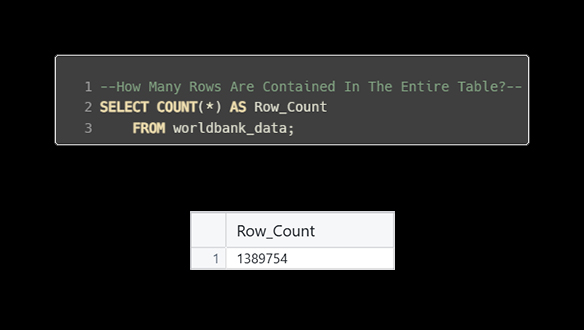
The first question I ask myself when dealing with any dataset, is "How much data am I actually dealing with?" Turns out this dataset has almost 1.4 Million rows of data and 29 fields.
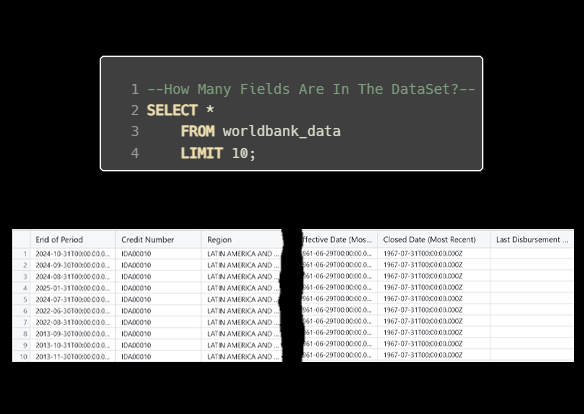
There isn't a direct SELECT query that will give you the number of fields, easiest thing to do is get all the data, LIMIT the results and count the fields manually.
Time to start drilling down into the data that just involves Kenya. Let's find out how many transactions involve Kenya and how much has been disbursed in USD ($).
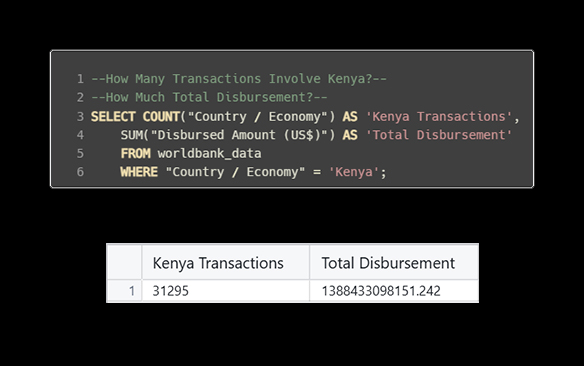
Nearly 1.4 Trillion USD has been given to Kenya as aid. The journey continues to find the Top 5 programs that are receiving the funds (and how much each has received).
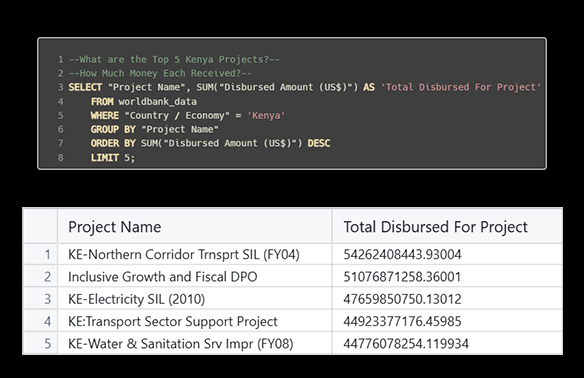
More information on the prjects that Kenya has put nearly $250 Billion to...
| Project Name | Description | Industry/Infrastructure | Project Years |
|---|---|---|---|
| KE-Northern Corridor Transport SIL (FY04) | Improved road transport along the Northern Corridor and enhanced aviation safety to meet international standards. | Transport / Aviation | 2004 - 2012 |
| Inclusive Growth and Fiscal DPO | Supported inclusive growth by improving fiscal management, governance, and encouraging private sector investment. | Governance / Fiscal Policy | 2020 - 2021 |
| KE-Electricity SIL (2010) | Expanded electricity access and improved reliability and financial performance of power utility. | Energy / Utilities | 2010 - 2012 |
| KE: Transport Sector Support Project | Improved transport efficiency and aviation safety across key national corridors. | Transport / General Infrastructure | 2011 - 2018 |
| KE-Water & Sanitation Srv Impr (FY08) | Increased access to water and sanitation in urban areas through infrastructure and service upgrades | Water & Sanitation | 2008 - 2015 |
Now, let's take a look at the other financials (Disbursed, Undisbursed, Cancelled) when it comes to these 5 projects, also, is an money owed back to the IDA?
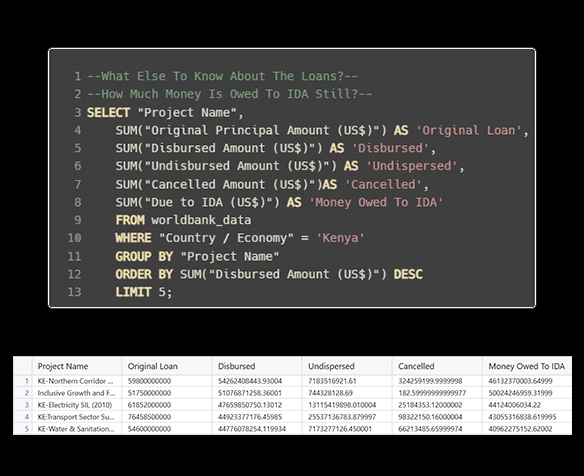
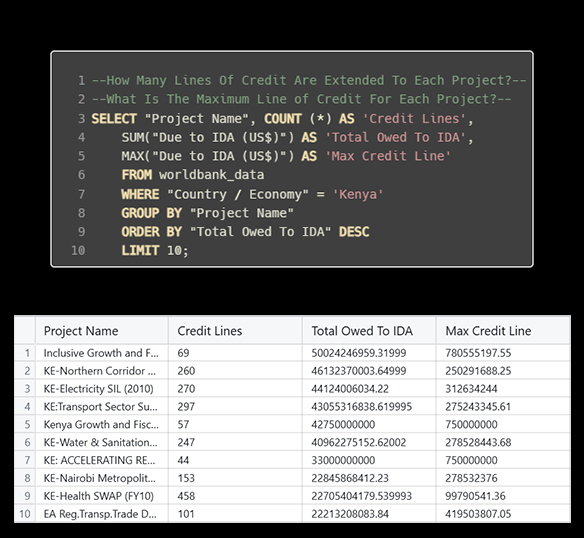
Even with just over $500 Million cancelled, Kenya still owes the IDA nearly $225 Billion. Taking a deeper dive, let's find the number of lines of credit extended for each of the top 5 projects and the biggest payment on each still owed to the IDA.
>
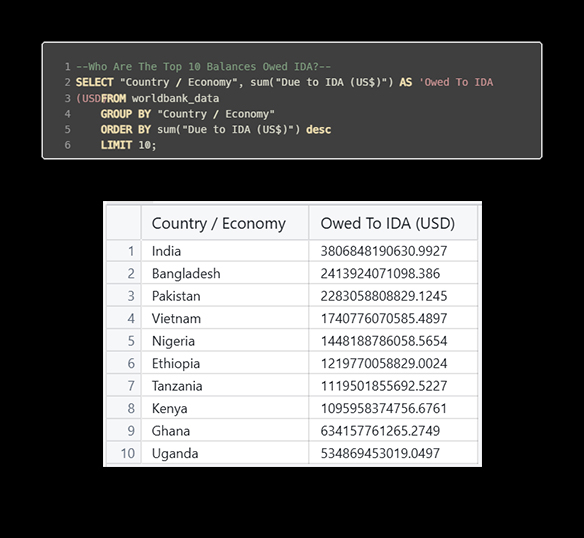
These are just the numbers from the top 5 projects, when compared to other countries, Kenya ranks 8th in funds owed to the IDA.
Insights & Main Takeaways
Massive Investment, Focused impact
Nearly $1.4 Trillion USD in international aid has been directed to Kenya, with the Top 5 projects alone receiving almost $250 Billion USD. These funds primarily support health, food security, and democratic governancel.
Over $500 Million Cancelled: A Red Flag?
Despite large investments, over $500 Million USD in aid has been cancelled across the top projects—raising questions about implementation issues, shifting priorities, or administrative inefficiencies.
Debt Remains a Heavy Burden
Kenya currently owes nearly $225 Billion USD to the IDA, even after cancellations and disbursements—highlighting the growing challenge of balancing development aid with long-term debt sustainability.
Kenya is the 8th Highest Debtor to the IDA
In global comparison, Kenya ranks 8th in total funds owed to the IDA, underscoring its significant reliance on concessional loans within the World Bank’s aid ecosystem.
What Happens Next?
I invite you to connect with me on LinkedIn. If you or someone you know is looking to hire a data analyst, let’s chat. I’d love to hear your thoughts on this analysis or any questions you might have./p>